Kashmir Online Store · Embroidered Stoles
Jama Nafki Tusha Stole
Every inch of the ground, covered.
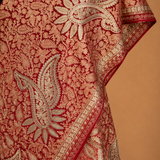
A deep maroon Tusha stole worked end to end in Nafki embroidery — blush and peach vines running across the field, large cream and antique-gold paisleys anchoring the corners, and a fine woven border closing the edge.
Jama
Full-ground coverage
Maroon
Peach, cream & gold
The Piece
Why a jama stole is different
In Kashmiri embroidery, jama means the work covers the entire ground rather than sitting in a border or a few scattered motifs. That single word accounts for most of the price difference between one embroidered stole and another — a bordered piece leaves the field bare, while a jama piece fills all of it.
Look closely at the photographs and you can see two registers at work: a fine peach vine that runs continuously across the field, and larger paisleys in cream and soft gold laid over it at the corners and along the fall. The paisleys are finished in the raised, corded outline that gives Nafki its character, so they sit slightly proud of the surface and catch the light differently as the fabric moves.
Material & Design
Tusha base, Nafki work
"The cloth is the canvas. The embroidery is the reason you buy it."
Tusha is the soft, lightweight fabric Kashmir uses for most of its embroidered stoles. It drapes easily, sits gently against the skin, and — unlike very fine pashmina — it has enough body to carry dense embroidery without puckering. That makes it the right base for a fully covered jama piece.
Nafki is a Kashmiri embroidery built on twin outlines: each motif is bordered twice, which raises its edge and separates it cleanly from the ground behind it. The design is filled vine-first, with the larger motifs layered on afterwards in changing thread shades. From a distance the surface reads almost as woven; up close the individual motifs and their raised edges become visible.
A crafted textile: slight variation in stitch density, thread shade and motif placement between pieces is normal in Kashmiri embroidery and is not a defect.
Key Highlights
What you are getting
- Full jama coverage — embroidery across the entire ground.
- Nafki work with raised, corded motif outlines.
- Soft Tusha base, light enough for indoor wear.
- Deep maroon ground with peach, cream and gold threadwork.
- Large paisley motifs at the corners and fall.
- Woven self-border and fringed ends.
- Suits weddings, festive wear and formal occasions.
- Sourced and dispatched directly from Kashmir.
Buying Notes
How to judge an embroidered stole
- Ask how much of the ground is covered — border-only pieces cost a fraction of jama pieces.
- Tusha and pashmina are different fabrics at very different prices. A pashmina claim at a Tusha price is a warning.
- Check the thread ends and the border finish — that is where rushed work shows first.
- Denser embroidery and more thread shades in one design both push the price up.
- The reverse of the cloth tells you as much as the front. Look at it before you buy.
- Photographs cannot fully carry deep reds. Expect a small shift between screen and cloth.
Styling
How to wear it
1Over a plain outfit — the stole is doing all the work, so keep the base solid and unfussy. Ivory, black and deep green sit well against the maroon.
2Draped one-shoulder — as shown in the photographs, letting the corner paisley fall to the front where it is visible.
3With a saree or kurta — a traditional pairing for weddings and winter functions.
4As a gift — a jama piece works well as a wedding, Eid or milestone gift.
Product Specifications
The details that matter
| Attribute |
Details |
| Product |
Jama Nafki Tusha Stole |
| Base Fabric |
Tusha |
| Embroidery |
Nafki |
| Coverage |
Jama — full ground |
| Base Colour |
Deep maroon |
| Thread Colours |
Peach, blush, cream, antique gold |
| Finish |
Woven self-border with fringed ends |
| Care |
Dry clean only |
| Origin |
Kashmir, India |
Slight variation in colour, motif and finish between pieces is natural and not a defect.
Care
Making it last decades
An embroidered Tusha stole is not a wash-and-wear textile. Water and detergent loosen the threadwork and can bleed dye from a deep maroon ground into the pale embroidery, which cannot be undone. Dry clean only — no washing at home, no wringing, no bleach.
For storage, fold along the existing folds and keep it wrapped in cotton or muslin rather than a plastic bag, which traps moisture. Keep a natural moth repellent nearby and air the piece out once or twice a season. Treated this way, a good jama stole outlives the person who bought it.
Want it in another colour?
We can source this design on a different ground, in another embroidery, or arrange a matching set. Message us before ordering and we'll send options.
Ask on WhatsApp
Frequently Asked Questions
Good to know
What is Nafki embroidery?
A fine Kashmiri embroidery worked in twin outlines that give each motif a raised, corded edge. On this stole it fills the ground almost entirely rather than sitting only along the border.
What is a Tusha base?
Tusha is a soft, lightweight fabric used widely in Kashmir for embroidered stoles — warmer and more affordable than pashmina, and better able to carry dense embroidery because it has more body.
What does jama mean?
Jama means the embroidery covers the entire ground of the stole rather than being limited to a border or a few scattered motifs. It is the most heavily worked style of Kashmiri stole.
Will two pieces look exactly the same?
Slight variation in colour placement and motif detail is normal between pieces, and screen colours may differ a little from the actual shade of the cloth.
How do I care for it?
Dry clean only. No washing at home, no wringing, no bleach. Store folded in cotton or muslin rather than plastic, with a natural moth repellent nearby.
Is this suitable for gifting or occasion wear?
Yes — the deep maroon ground and dense gold-toned embroidery make it a wedding, festive and formal-occasion piece, and it presents well as a gift.